

Aegis Power Systems continues to be a subject matter expert regarding power supply and power conversion technologies for rugged military systems. We were recently asked to provide insights to Military Embedded Systems’ Dany Taylor for an upcoming article on changing power requirements in defense systems and what types of innovations are driving success in these spaces. In general, we are seeing modular design approach, high power density, and high efficiency as the best ways to achieve success with respect to power supplies, battery chargers, and power converters in modern defense equipment.
Our President, Ron Gaw, provided the following detailed insights in the full transcript of the interview from Military Embedded Systems:
Dan Taylor: What new or emerging technologies do you see as most promising for advancing military power supply performance in the coming years?
Ron Gaw: Of particular importance, intelligent power conversion that self-reports, providing critical operational information securely, stealthily, and in real time to enhance warrior asset awareness, reduce combat cognitive load and enable future system assets’ awareness capabilities. Of equally high importance, there are technologies that will provide high efficiency, low signature power transfer with increased stealthy deployment options to extend unmanned mission range and capabilities.
Dan Taylor: What kinds of challenges are today’s military platforms creating for power system designers, and how are companies adapting to meet them?
Ron Gaw: Today’s military platforms are beginning to mirror the increasing power demands seen in the commercial and consumer industry, though the mission is fine tuned to support critical energy for AI target identification, tracking and instantaneous battlefield intelligence needs, and future development of enhanced intelligence enablers for delivering real time predictive solutions in complex battlefield scenarios. Power systems designers are solving these complex electronic power delivery design challenges now, including the need to adapt to a wide range of input power sources, the need to output higher voltages and lower current as enablers for lighter overall systems, the need for packaging the power conversion product itself in increasingly smaller, more mobile and faster assets, and the need to provide real time response to changing power demand and power conversion input / output telemetry.
Dan Taylor: What demands are customers making today when it comes to SWaP, efficiency, and reliability?
Ron Gaw: Today’s power products are required to employ the latest technology in advanced power conversion and power factor correction, demanding 90% or higher efficiency at the output and little to no harmonic distortion at the input. Reliability is still very important, but so is supply-chain and sourcing of components. US customers are increasingly demanding US-sourcing.
Dan Taylor: When you think about operating in extreme or contested environments, what design considerations become most critical for power systems?
Ron Gaw: While most aspects of power systems that are critical in contested environments have not changed (e.g. rugged structures and clean power), other aspects are going to take center stage at a much higher priority. Power conversion efficiency will be one of the most critical, as this will directly impact the mission length, capability and logistical support demands. This will also lead to lower cooling demands in critical systems, which means the parent systems themselves will see lower weight, package volume and energy usage.
Dan Taylor: Looking ahead, what defense applications or mission types do you think will drive the next wave of innovation in military power technology?
Ron Gaw: The definition of battlefield is evolving quickly, where the first wave of an aggressor’s attacks may very well be digital attacks on energy sources and of a scale not seen before. Power resiliency won’t be enough – redundancy will be a critical factor in ensuring all U.S. assets remain connected with full battlefield physical and digital capability intact. That doesn’t just mean rugged enclosures and electrical resilience, it means capability to rapidly deploy power to anywhere, from any source to other more critical sources. It also means every asset is enabled to step in and contribute to the continuation of the mission, while delivering the mobility and stealth capabilities our warriors and their mission-critical assets have not seen before, while additionally reducing significantly the logistical burdens associated with today’s armed force missions.
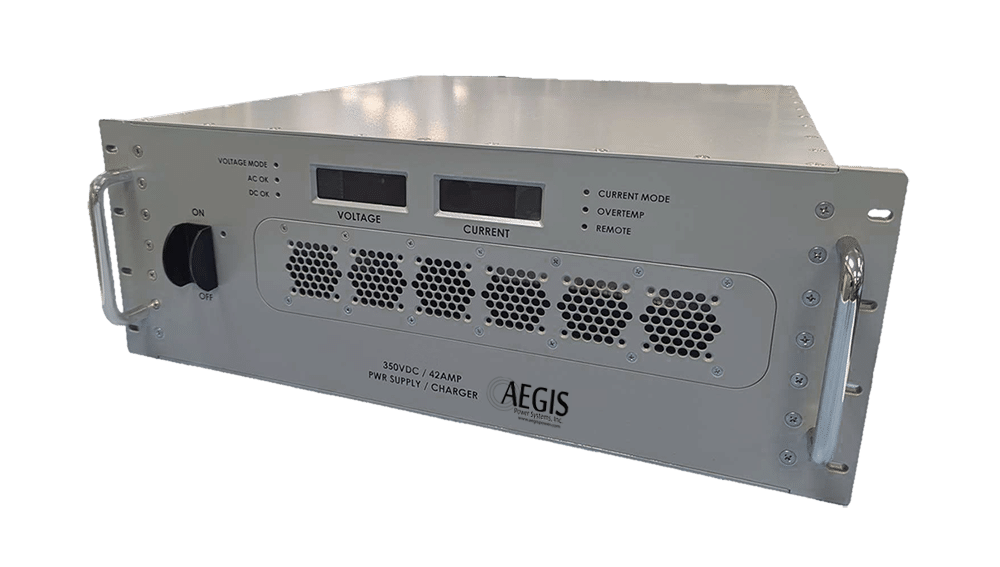
As an example of a modular US-sourced design that provides users in the above mission types with high efficiency and power density, Aegis recently developed the AP31F44017K5M power supply / battery charger, which is a unit that provides 440VAC to 375DC power for a battery-powered application in a naval environment. The electrical architecture is designed in a modular approach so that other voltage variations could be deployed. This unit offers very high efficiency, >11kW power output in a 19″ rackmount form factor, and a variety of rugged features for military environments. The design and components are US-sourced. This type of power conversion equipment is a necessary enabler for modern warfare.
Please see related article from Military Embedded Systems by Dan Taylor, titled “Power under pressure: Meeting the military’s surging energy demands,” for additional insights: https://militaryembedded.com/comms/power-electronics/power-under-pressure-meeting-the-militarys-surging-energy-demands